Showing posts with label macro intervention. Show all posts

1.14.2014

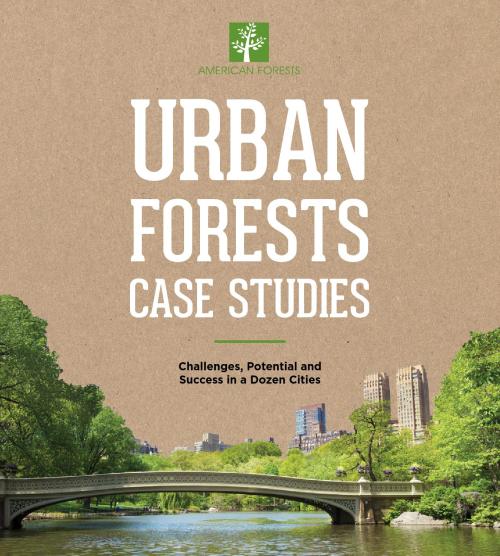
Urban Forest Case Studies: Challenges, Potential and Success in a Dozen Cities

Philadelphia featured in the USDA’s publication, Urban Forest Case Studies: Challenges, Potential and Success in a Dozen Cities

This publication represents extensive research, interviews and examinations into 12 cities that have begun — or are continuing — to make an investment in their urban forests in order to reap future gains.


1.03.2014

The Eye of Sauron? Réservoir Manicouagan


I spy a circular-looking water body that looks almost like a ring, or maybe a flaming eyeball (maybe the Eye of Sauron?!) or perhaps an extremely large moat around the grandest of castles. Could it be a river or a lake? Is it Earthly? What is this un-natural looking ring of water?

Photo courtesy of http://brlndoblog.blogspot.com
Photo courtesy of NASA

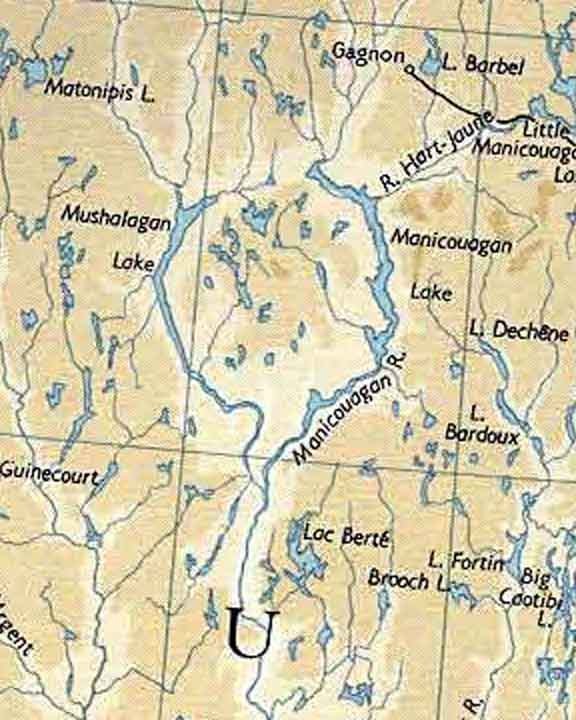
While virtually roaming the New York North Country and Quebec via Google Maps; I spotted a peculiar, circular waterbody with a land mass in the middle...or was it spotting me? This "eye of Quebec" is called  Lac Manicouagan, which surrounds a body of land known as René-Levassuer Island. The island is home to 2 reserves-- Réserve de biodiversité de la Météorite and Réserve écologique Louis-Babel. Before the area was dammed in the 1960's, the water body was actually 2 water bodies-- Lac Mouchalagane to the west and Lac Manicouagan to the east.

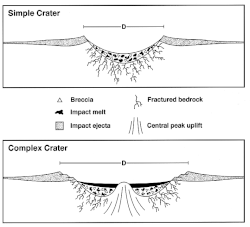
So, what formed the two odd lakes side by side? As one of the "Seven Wonders of Canada," this now one waterbody is known as an annular lake or moat 1, which is a lake formed from a meteor impact and also called an astrobleme. When meteors have such a dramatic impact, they form complex craters with multiple rings, where the middle of the impact uplifts and creates a land mass similar to Manicouagan's. The 60-mile wide impact was so intense, the molten rock took thousands of years to cool (between 1,500 - 5,000 years) 3. The crater is thought to be 213-215 million years old and may have been a part of a multiple impact event, as it forms a theoretical line on the late Triassic continents of North America and Eurasia with other craters, such as Red Wing Crater in North Dakota and Rochechouart Crater in France 4. Interestingly, because of its unique geology, it is considered as a useful analog of other impact structures on other planets, such as Noachian Mars, for space exploration and study 8.


1962 Map of the Lakes before "Damnation" 1

The reserve today 2

Diagram courtesy of Wikipedia  4


 Earth 214 Myr ago,  showing the locations of the five impact structures. 6 

  
The uplifted region-- Mount Babel and its island, Rene-Levasseur Island-- is not only geologically interesting and the second largest lake island in the world, it has a wealth of biodiversity due to its quick transition from the boreal forest to tundra. The reservoir and island are located in the Boreal Shield ecozone and the Central Laurentians ecoregion 9. The rugged terrain hosts species from the boreal ecosystems, which are dominated by black spruce, fir, alder, jack pine, sphagnum and architectural sightings of krummholz; and tundra communities dominated by lichens and blueberries. 91% of the forest stands on the island are older than 100 years and the island houses almost 1,651 hectares of peatland 4,5. Protected peatlands are scarce, as only 3.5% of Quebec's peatlands are protected 5. Moose and caribou are common on the island.  Atlantic salmon, lake trout and northern pike can be found in the reservoir 1.

    
 Impact melt cliff  of the central peak island. 3
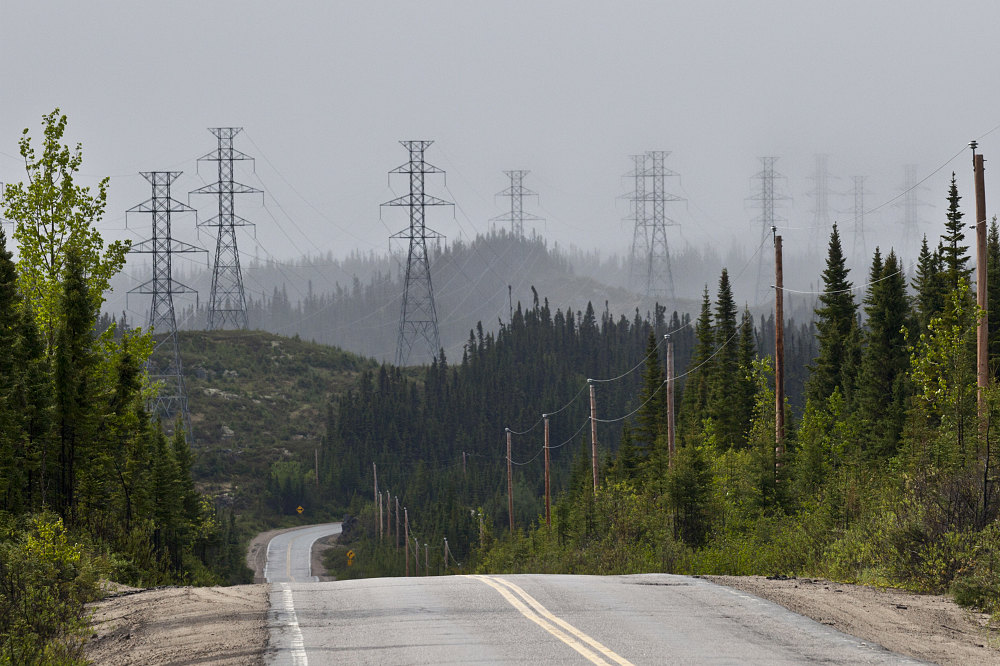
In the 1960's the lake was dammed for hydroelectric power and now supplies power all the way down to New England. The height of the dam is 214 m and some research suggests that the magnitude of the dams in this region have induced seismic activity 10. The lake gets the lowest during the heat of the summer, when New Englanders turn on thier AC's. Wikipedia reports that the chief engineer for the dam, Rene Levasseur, and Dan Johnson, the Premier responsible for the project, both died young from heart problems. Apparently, the native Innu believe that just as the men clogged the rivers, the Earth's veins and arteries, the creator responded by clogging theirs, a belief which could reflect the cultural conflicts of the region. However, this may simply be a rumor, since Wikipedia has no source for this statement. However, there are reports of several conflicts between the native communities and the energy companies. Nonetheless, it fits well into the story of Tolkien's evil eye, the Eye of Sauron....my precious!

A non-profit group, SOS Levasseur acts to protect the unique ecological and cultural resources of the island from destructive activities such as logging and mining, and performs research on the island. Another organization which encompasses all the reserves in the area is called Réserve de la biosphère Manicouagan-Uapishka, designated by UNESCO in 2007. We can't help but wonder what this place would be like if the dam were never built or the logging never occurred. Réservoir Manicouagan looks like a fascinating place to visit and we just might have to add it to the bucket list!


Dams within the Manicouagan-Outardes complex. 10

Manic 5, Daniel Johnson dam. Photo courtesy of http://i.imgur.com

Power transmission along Highway 389. Photo courtesy of http://alavigne.net


Blueberry in a lichen in nearby Mondiale Reserve. 
Photo courtesy of Louis Laliberté

Innu folks fishing. Photo courtesy of Photo Lorcan Otway 1994.
Deforestation on the island. Photo courtesy of Greenpeace.

Ancient forest of the island 7


Vegetation found on the island by SOS 7
If anyone knows this species, please let us know!


http://www.staff.science.uu.nl
2 Gouvernement du Québec, 2009. Réserve de biodiversité de la Météorite – Conservation Plan. Québec, Ministère du Développement durable, de l’Environnement et des Parcs, Direction du patrimoine écologique et des parcs. 24 pages.
4 Wikipedia
686672 (1998): 171-173.
Spray, John G., Lucy M. Thompson, Marc B. Biren, and Catherine O’Connell-Cooper. "The Manicouagan impact structure as a terrestrial analogue site for lunar and martian planetary science." Planetary and Space Science 58, no. 4 (2010): 538-551.
9 Ecological Stratification Working Group, 1996. A National Ecological Framework for Canada. Agriculture and Agri-Food Canada, Research Branch, Centre for Land and Biological Resources Research, and Environment Canada, State of the Environment Directorate, Ecozone Analysis Branch, Ottawa/ Hull. Report and national map at 1:7 500 000 scale.
10 Leblanc, Gabriel, and F. Anglin. "Induced seismicity at the Manic 3 reservoir, Quebec." Bulletin of the Seismological Society of America 68.5 (1978): 1469-1485.

8.16.2012

The Dutch Know Bikes


The Dutch build bicycle lanes into the intersections to remove the need for the driver of a vehicle who wants to turn right from having to look over their shoulder.  A tricky maneuver for anyone driving, healthy neck or not. It is my take that the bike wanting to go "straight" maintains the right of way.   Its a really interesting concept and removes the need to widen the corner.  Check it out:


7.30.2012

Macro Intervention: Glass Beach


Quite possibly the most beautiful dump in the world, no amount of  intellectual design effort that is now currently applied to projects such as Fresh Kills in NYC could possibly hope to create the tumbled glass splendor at Glass Beach.  Only decades of waste disposal hurled off of the cliffs at Fort Bragg, California  by its residents could make something that amazes in its dichotomous splendor. They discarded glass, appliances, and even cars. The land was owned at that time by the Union Lumber Company, and locals referred to it as "The Dumps." Sometimes fires were lit to reduce the size of the trash pile.


In 1967, the North Coast Water Quality Board and city leaders closed the area. Various cleanup programs were undertaken through the years to correct the damage.


Over the next several decades the pounding waves cleansed the beach, wearing down the discarded glass into the small, smooth, colored trinkets that cover the beach today.  In 2002, the California State Park system purchased the 38-acre (150,000 m2) Glass Beach property, and after cleanup it was incorporated into MacKerricher State Park.


NOTE:  Photos courtesy of ++ Colossal


http://www.thisiscolossal.com/2011/08/glass-beach/
http://en.wikipedia.org/wiki/Glass_Beach_(Fort_Bragg,_California)


6.15.2012

Macro Intervention: A Play Street in Amsterdam

Photo courtesy of landezine.com

Potgieterstraat is situated in inner Amsterdam, in a context of 19th century buildings dating back to the first big enlargement of Amsterdam.  Amsterdam is world renowned for its walkability but this street in particular was heavily dominated with vehicle traffic.  In addition, new bike lanes had infortunately infringed upon the sidewalk rather than the vehicluar lanes.(1)

Carve Landscape Architects' response was to create a "Play Street" where the entire street was closed to all but bicycle and pedestrian traffic. 

Photo courtesy of landezine.com

(1) http://www.landezine.com/index.php/2012/06/potgieterstraat-by-carve-landscape-architecture/

6.07.2012

Highland Brewery: Low Impact Beer


In 1994 the Highland Brewery began brewing beer in downtown Asheville, North Carolina with some refurbished dairy equipment.  I was lucky enough to take a "tour" back in 2001 which consisted mainly of standing in place and drinking.  My pint was joyfully snatched from my hand and refilled every time it was 1/4 of the way below the rim: the proverbial never emptying glass.  Needless to say the rest of the workday was shot, but the beer was well worth it.


Fast forward 11 years and I find myself living in Philadelphia, inspired by the writings of Paul Hawken, and Amory Lovins (among many, many others) looking for companies, leaders, and designers that are trying to move towards a capitalism that is more complete.  I was additionally inspired by a John Todd who lectured at the Academy of Science and spoke about how, during his tenure with UVM, he worked with the Magic Hat brewery in Burlington, VT to develop a closed loop brewing process.


This was of particular interest to me for two reasons:  UVM and Magic Hat were just across the lake when I was growing up, and...I love beer!  So I decided to look close to Philadelphia and wrote a little something about Dogfish Head Brewery


I then set upon a mission to track down all my favorite beers and see if and how they fit in to my other interest of what Hawken calls, Natural Capitalism.  The first on the list is Highland Brewery, a favorite beer brewer of mine and one of the biggest things I miss about living in North Carolina, and Asheville in particular.  All of their beers are amazing and full bodied...the Kashmir IPA and the Oatmeal Porter are my personal favorites.  Highland's claim to fame is their malty yet well bodied Gaelic Ale.  It's a crowd pleasing beer


With regards to a green initiative they hit the trifecta of building reuse, sustainable manufacturing, and community stewardship.  You can click HERE for the particulars, but these guys try and do it all.

In terms of community outreach, Highland has partnered with the Southern Appalachian Highlands ConservancyAdopt-a-Stream, and Manna Food Bank, and offer support to other organizations in their tasting room.  And that room is amazing see below:

Tasting Room!

I toured again last May with a raucous group, had a blast, and could not recommend the facility more.  Part of that tour lead us to the French Broad River Brewery, but that is a blog for another day.... Cheers!


5.11.2012

Biomimicry

Photo courtesy of http://www.algaecompetition.com/algae-awards/
In the late nineties Janine Benyus wrote a seminal eco-capitalist book called Biomimicry: Innovation Inspired by Nature.  Adapted from a larger Deep Ecology philosophy, the basic precepts were to use Nature as a Mentor, Measure, and Model for how we design and inhabit the planet.  One particularly striking idea was the use of a biotic method for producing energy.  

Fast forward 13 or so years and the International Algae Competition challenged architects, engineers, scientists, algae enthusiasts and students from around the world to design visionary algae food and energy systems. This week, they have announced seven prize winners from the 40 finalists. (1)

A list of winners is below – click on the links to for visualizations from the individual prize winners and more detailed project descriptions. (1)


The Abundance Prize and Best Video

Green Loop: Marina City Global Algae Retrofitting, Chicago by Influx_Studio, Mario Caceres and Christian Canonico. (1)


Algae Landscape Design First Prize

Process Zero: Retrofit Resolution. GSA Federal Building, Los Angeles, CA, by Hok/Vanderweil, Sean Quinn. (1)
Urban Algae Culture in Gangxiacun, Shenzhen China, by Kady, Wong Hoi Kei & Kate, Lau Hoi Ying & Perry Li. (1)


The Algae Production Systems First Prize

Circular Tank Technology to reduce production costs, by Vincent Guigon, Antenna Technologies, Geneva.
Organic spirulina microfarm with biogas plant. Normandy, France, by Laurent Lecesve, Hybrid énergies & Eco-Systèmes. (1)


The Algae Food Development First Prize

Biosphere Instant Soup Concept by Lucie Bolzec, founder of Delis Design Studio, France.
Dances With Algae, by Lynn Cornish, Scott Hubley, Romelda Nickerson, Josie Todd, Canada. Marine Algae Foods and Recipes. (1)


The Appreciation Prize, voted by participants

Algae Powered Mushroom Farm in Congo, Africa, by 10 Design Group, Ted Givins. (1)


Also, check out the amazing winners here:

http://www.algaecompetition.com/algae-awards/

(1) http://www.biofuelsdigest.com/bdigest/2012/05/11/peeking-at-the-future-of-algae-international-algae-competition-announces-winners/
1.03.2012

Recreating an Ice Age


Photo courtesy of Inhabitat


From out in the south of Chersky in the Sakha Republic in northeastern Siberia a Russian geo-physicist by the name of Sergei Zimovis is attempting to recreate the last ice age across 160 sq km of Siberian “desert”, a project he calls the Pleistocene Park.  Permafrost has heretofore trapped hundreds of thousands of tons of methane below its surface.  As the industrial revolution, the automobile, and all of our other favorite carbon releasing baubles march on in more and more countries, the Earth's climate, as we all have heard is warming...check that..."changing".  This "change" is causing the permafrost to melt thus releasing methane like so many Taco Bell restaurant patrons.


Photo courtesy of Inhabitat


But wait, Zimovis disagrees.  His theory is that the herbivores grazing on that land kept it in its tundra-steppe, a cold, dry grassland state and that over hunting of these large animals, not climate change, led to their extinction.  He attributes the following ecological reasons for the warming of the land with regard to herbivore extinction:
  1. Herbivores were no longer present to maintain the grassland ecology
  2. "Grasses and their root systems stabilize the soil." 
  3. "The albedo—or ability to reflect incoming sunlight skyward—of such ecosystems (grasslands) is high, so warming from solar radiation also is reduced"
  4. "With lots of herbivores present, much of the wintertime snow would be trampled, exposing the ground to colder temperatures that prevent ice from melting."
According to Zimovis, all of this suggests that reconstructed grassland ecosystems, such as the ones we are working on in Pleistocene Park, "could prevent permafrost from thawing and thereby mitigate some negative consequences of climate warming.”


“The ecosystem that used to be here many years ago cooled the climate substantially. And the present-day situation – I mean climate warming and the melting of permafrost – is a separate problem which we are seriously engaged in. We came to realize that the revival of a rich ecosystem on a vast territory will considerably affect the climate and help us control the process of global warming. Scientists find hundreds of kilograms of mammoth-epoch bones on every hectare of northern Yakutia, which testifies to the bygone abundance of herbivores and a different landscape. Our objective is to find out why the situation varied so much after all.”


Zimovis has applied his theory to  Pleistocene Park  where he knocked down the trees and introduced grazing animals to feed on the grass.  Oddly enough, the research on the Park indicates that Zimovis may be correct. He has garnered attention from as far off as Princeton University.  He is looking to, with proper funding, scale up the research. 

Photo courtesy of Inhabitat


Read more: Geo-physicist Tries to Recreate an Ice Age Ecosystem in Siberia to Prevent the Release of 500 Billion Tons of CO2 | Inhabitat - Green Design Will Save the World 

MSNBC 

12.30.2011

La Place du Geant


In July of 2011 Collectif Etc. brought to life their winning idea for a vacant urban property named by its neighborhood, La Place du Geant (officially named Place au Changement Public Plaza).  The project was selected in a competition sponsored by The Public Urban Planning Agency of (France) winning entry by the Collectif Etc.  

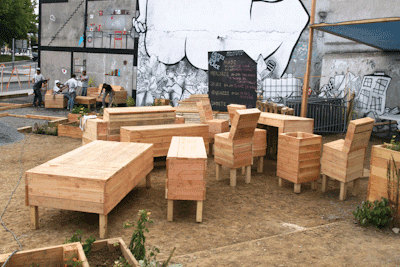
Developed as a temporary installation, its bold an unique strategy involved asking the community to imagine what the 7,000 sqft property might look like if it was filled with a building and then create structure that reflected that image. "The idea was to represent the plan of imaginary housings on the ground and their section on the wall."   People could then get a sense for what a future building might look like in that space.

Several workshops were offered that provided useful training in the form of carpentry, construction, graphic design, landscape design, and landscape maintenance. The construction was open to the public with Collectif Etc. acting as the oversight committee providing logistics, organization, and tools for the community.

Neighbors have given it the name, La Place du Geant  because of artists Ella&Pitr large painting.  Naming is an important part of place making; particularly a name given by its users.  Such an event connotes ownership and value.  And with an inclusive process to imagine the future, this neighborhood has created a space that has so far proved to be functional and social within its context.


All Photos Courtesy of Collectif Etc.

Jett , Megan . "Place au Changement Public Plaza / Collectif Etc" 31 Oct 2011. ArchDaily. Accessed 30 Dec 2011. <http://www.archdaily.com/179874> 

12.29.2011

A Citizen Architect and the Role of Design in a Land-Grant University

Photo Courtesy of The Rural Studio


 “That is the reason you go to college, not to make more money, but to gain the knowledge to make this a better world.”
– Sambo Mockbee


Citizen Architect is a well regarded film that highlights some of the best work done by the Rural Studio at Auburn.  It has been around a while, but its merits and the debate it inspires still hold true as it passionately lays out the role of Design in a land grant university.  It re-examines an age-old dispute carried forward from the inception of modernism and subsequently post-modernism, post-structuralism and deconstruction.  The movie does let Peter Eisenman eloquently express his point of view, however it clearly favors "architecture for the people" as opposed to "architecture as artistic expression".   The last part of that sentence wholly and unjustly oversimplifies both points of view because as with many theological debates, the more one tries to draw distinctions, the closer each becomes to the other.


Through this film one can see how the merits discussed during the now famous and expletive laced 1982 Harvard debate between Peter Eisenman and Christopher Alexander carries into the Land Grant vs. Ivy League discussion.   Again, that is a general statement that oversimplifies not only the role of each type of university but their position on the function of architecture in society.  But what is apparent, is that, in a manner similar to what is espoused by Alexander, Mockbee and the Rural Studio endeavor to build a reality of functional and esthetic architecture for undeserved communities.  Perhaps Mockbee's greatest contribution is the recognition that the idea of architecture as high art exists along a spectrum with socially conscious architecture.  That Design is not what one believes, it is what one makes.

Regardless of your worldview, or what university you attend, or attended, or teach at, Citizen Architect  should be required viewing for anyone in the architecture/landscape/planning/engineering fields, and especially those who are looking to enter those fields.


Photo Courtesy of samaulamockbee.net


3.06.2011

Macro Intervention: The State Street VIllage, Raleigh

A megalopolis of single family homes arranged in a spider web of cul de sacs and cheap apartment buildings built around parking lots spreads along the I-85 corridor from Atlanta, Georgia to Raleigh, North Carolina.  From the perspective of contemporary urban planning and design theory, one could say that Raleigh North Carolina probably ranks right up there with sprawled out, petroleum based cities like Las Vegas, Los Angeles and Orlando.  In some ways, it's worse.  No light rail, miles and miles of highways and a transportation lobby that seems only interested in making those highways wider.

The Research Triangle Park is in many ways the economic life blood of what is called the "Triangle" of Raleigh, Durham, and Chapel Hill.  For all of its 7,000 acres it's public transportation connections consist of 1 bus stop. Other nearby places are now challenging the big three for dominance such as Cary and Holly Springs.  All of these towns suffer from the same lack of public transportation and rely on a cheap supply of gasoline. One can say that our entire nation is dependent on gasoline, and that is true, we are.  However, places like Raleigh, because of their severe lack of transportation alternatives, are a canary in the coal mine for the repercussions of oil price spikes.

Oddly enough, within this rubric of unsustainable urban sprawl, we find one of the more sustainable practices of urban reuse one could hope to find in such a place.  It's called the State Street Village. It is being created by the non-profit, Builders of Hope that advocates and practices the up-cycling of homes all over North Carolina.  Their goal is to build safe, walkable communities by reusing the homes others no longer want or have the ability to rehabilitate.

The State Street Village project  involves 25 lots off of a new cul-de-sace off of State Street in south Raleigh- with homes starting just over $100 thousand.  For that buyers get spacious lots, quality homes, a great view of downtown and the chance to be part of improving our city as a whole.  State Street Village represents a redevelopment strategy that starts with creating a community that has great fundamentals and is cohesive aesthetic.

The houses are donated and transported from all over the area.  They priced below market value, but are a quality offering beyond both older and new homes.  Builders of Hope guts the frames- rewires them, plumbing, installs new or recycled finishes, new energy efficient appliances, energy efficient windows, and insulates them tight. The offer is one for people, who may not otherwise have a chance, to have a home to be proud of. The homes are built for quality with a focus on energy efficiency and aesthetics.  Builders of Hope works with Advance Energy to certify each house for energy efficiency.  Advanced Energy seals the house and tests for energy loss through the floors, walls and openings.  The certified homes are incredibly efficient and much more affordable to heat and cool.

New Urbanists will raise their arms a wail about the cul de sac.  Landscape Urbanists will argue that it lacks attention to the site and connections to public transporation. Maybe they are both right, but have either of those groups thought of an idea this good?  Or better yet have they built anything this well.  It is in the making that creates the thing, and neither theory has actually made/created/built anything that address the three basic tenants of sustainablity (economy, ecology, equity) as thouroughly this small non-profit.  Waldheim and Duany, please take notes.