Showing posts with label landscape architecture. Show all posts

2.02.2013

Edinburgh Gardens Raingarden

Image courtesy of Landezine
In 2010 GHD Pty Ltd designed this recently constructed and elegant raingarden for Melbourne Water in collaboration with City of Yarra at the Edinburgh Gardens: St Georges Road- Fitzroy North in Melbourne, Australia.  It was constructed on on the site of the demolished Ladies Bowling Club within the southern section of the park and it is intended to improve the health of Merri Creek and the Yarra River by filtering pollutants from captured stormwater. 1

Some of the facts and figures brought to us by our friends at Landezine are below, but we were impressed on first glance by the overall composition and diagram. A thoughtful design apparently well executed. Although, we would probably have to contact the City of Yarra to find out how it is truly performing. In the meantime, enjoy the some of the initial info and the eye candy!


Nice Diagram! Image courtesy of Landezine
"The raingarden is to provide a sustainable source of treated stormwater for the parks mature trees and sporting fields in a way that added to the existing landscape character of the park and added interest for users. Melbourne has experienced drought conditions for a number of years now and this project was to replace the existing need for potable water being used to irrigate our parks and gardens.

This raingarden is designed to remove 16,000 kg of annual total suspended solids per year of operation. It will also remove a further 160 kg of nutrients, phosphorus and nitrogen, through vegetation growth. This litter and pollutants would otherwise end up in Melbourne’s waterways. Filtered water is then collected into a 200KL underground storage tank, and used to irrigate existing trees within the Edinburgh Gardens; providing around 60% of their irrigation needs in a normal year.

In a normal year, the raingarden is expected to reduce potable water use for irrigation by 4 ML per annum.
The project involved sourcing stormwater from the North Fitzroy Main Drain and diverting it to a newly designed terraced raingarden within the Edinburgh Gardens, with the treated water being harvested for storage and irrigation of the trees within the park and local precinct.

Image courtesy of Landezine

The main components of the project were:
  • Diversion pipe from North Fitzroy Main Drain with gross pollutant trap
  • Surcharge pit into 700 sq.m rain garden.
  • Terraced raingarden with appropriate planting and filter media to treat stormwater.
  • Overflow pit with underground pipe connected to 200 kilo-litre underground storage facility with pump to irrigation distribution.
As described above the majority of the works undertaken to achieve this were underground with the large raingarden providing the visual element. The main design features of the raingarden are:
  • Native plant species planting
  • Filter media and appropriate plants that help to treat the stormwater through uptake of excessive nutrients and filtering fine sediments.
  • Four large terraces that respond to the sites natural grade, therefore minimising the requirement for taller retaining walls and balustrade, allowing informal public interaction,
  • Terrace walls that extend out into the landscape to create lawn ‘room’ areas for passive recreation. These areas will create elevated views over the raingarden and provide different spatial experience in this area of the park which is currently characterised by large unbroken lawn areas.
  • The strong lines of the extended terrace walls is repeated in the bands of planting in response to the recent history of the site as the location for the Inner Circle Railway Line.
  • A ‘zig zagging’ feature steel low flow channel, connected to the surcharge pit, that delivers water to all four terraces in rain events.
  • New tree planting to provide shade and enclosure for new small lawn areas
  • Continuously curved edge to reinforce line of new shared path and existing avenue planting."2

 Image courtesy of Landezine

 Image courtesy of Landezine


 Image courtesy of Landezine

 Image courtesy of Landezine

 Image courtesy of Landezine

Works Cited:
1 http://www.yarracity.vic.gov.au/Environment/Parks-and-reserves/Edinburgh-Gardens/Proposed-Raingarden/
2  http://www.landezine.com/index.php/2012/10/edinburgh-gardens-raingarden-by-ghd-pty-ltd/

7.09.2012

Meadows: From Livestock Feed to Landscape Design Popculture

Gene and Ben in a hay field, Perrys Mills, NY
 Before the meadow experts draw their metaphorical knives, let me first say that I recognize that there are different types of meadows and that I am not an expert in any of them.  I know that there are perpetual meadows from alpine to coastal and everything in between that stand to discredit the title of this blog.  But it seems as though every presentation, every rendering, and every landscape design is clearly discussing what was heretofore known as a hay field.  Clients, unless it is truly a project where a perpetual meadow naturally occurs, or a research facility, or a hardcore Eco-wealthy tycoon, are not going to introduce the types of conditions required to maintain those meadows.  Thankfully it is quite rare that someone would set fire to a field of tall grasses.

Agricultural meadows are not rare on farms in upstate New York where I grew up. There, we just called it "hay" (although the family farm is itself truly becoming a thing of rarity).  If you were lucky and had the right field you got a second or third cut and you didn't leave it in the field to dry for "good winter color".  And, if it was long enough to cut, you cut it for feed.  The winter color near my house was severely stunted by a 6" haircut that was soon covered with snow that was then soon covered with a layer of dried or liquified manure.  The effects of this practice are hotly debated particularly this year in the Champlain Valley where the blue-green algae blooms threaten the life within Lake Champlain, not to mention the tourist and recreation associated with summer fun.

Those hay fields were not described in glowing language meant to sell a design concept.  It was a fact of life and a toilsome one at that.  I was too small to really be involved in the process and did what I could apart from not getting stepped on.  It was a lot of long hours cutting and bailing, loading and unloading, stacking and unstacking and finally feeding and cleaning manure. When it was time to "do hay" my father would climb from what we called the hay mow, an elevated barn attic where bailed hay is stored for the winter, looking as if he had been caught in a heavy rain.  A literal heavy rain, the man was exhausted.

I've described a simple process made romantic in my telling and somehow cheapened by master degree holding esthetes: a club in which I clearly hold a card.  I say that perhaps to assuage the dread that I may be morphing into a griping middle-aged man lost in the noble past.  Maybe I am.  Or maybe I can't help but acknowledge not only the hypocrisy inherent in the sale of a "meadow" as a design element, but that I am, even in my criticism, inherently and inextricably connected to that hypocrisy.  The day I, like so many others of my generation, left the rural homestead to pursue higher education I both forfeited my right to defend the farm life and the right judge others who, like me, are so entirely over educated that they need to rediscover that noble past.

So now we have urban chickens, urban farms, urban bees and urban meadows.  All of which I took for granted and all of which I now see in an entirely different way.  And somehow it irks me that my urban and suburban born friends are becoming enlightened to this fact.  Maybe its because what I wanted most was to have all the things they did growing up.  That I grew up in a way that was different and difficult and somehow that chip is slowly being tipped from my shoulder.

And I feel like I carry another secret: it's that is there is a reason why my generation left those farms.  It's hard.  Beekeeping is hard.  Doing hay is hard.  Putting up fence is hard. Catching cows when they get out is hard.  Keeping chickens alive is hard. The "evil" of  large scale industrial farming is not abstract and the people affected directly by it are real.  Like warriors or athletes it's a lifestyle that makes men and women strong in their youth and wears on them in old age.  Not everyone is cut out for that life and when I hear about concepts deployed by newly minted experts as a weekend warrior activity or a design aesthetic I am somehow on some level oddly offended.

So the dilemma I face isn't the acceptance of agricultural processes as pop-culture (something that has been done more or less since the advent of agriculture), it's that I haven't been able to let that chip fall.

6.26.2012

PA-DE ASLA Student Awards

Image by Anna Anisko, Sue Ann Alleger, Tracey Lee-Carney and Bing Han

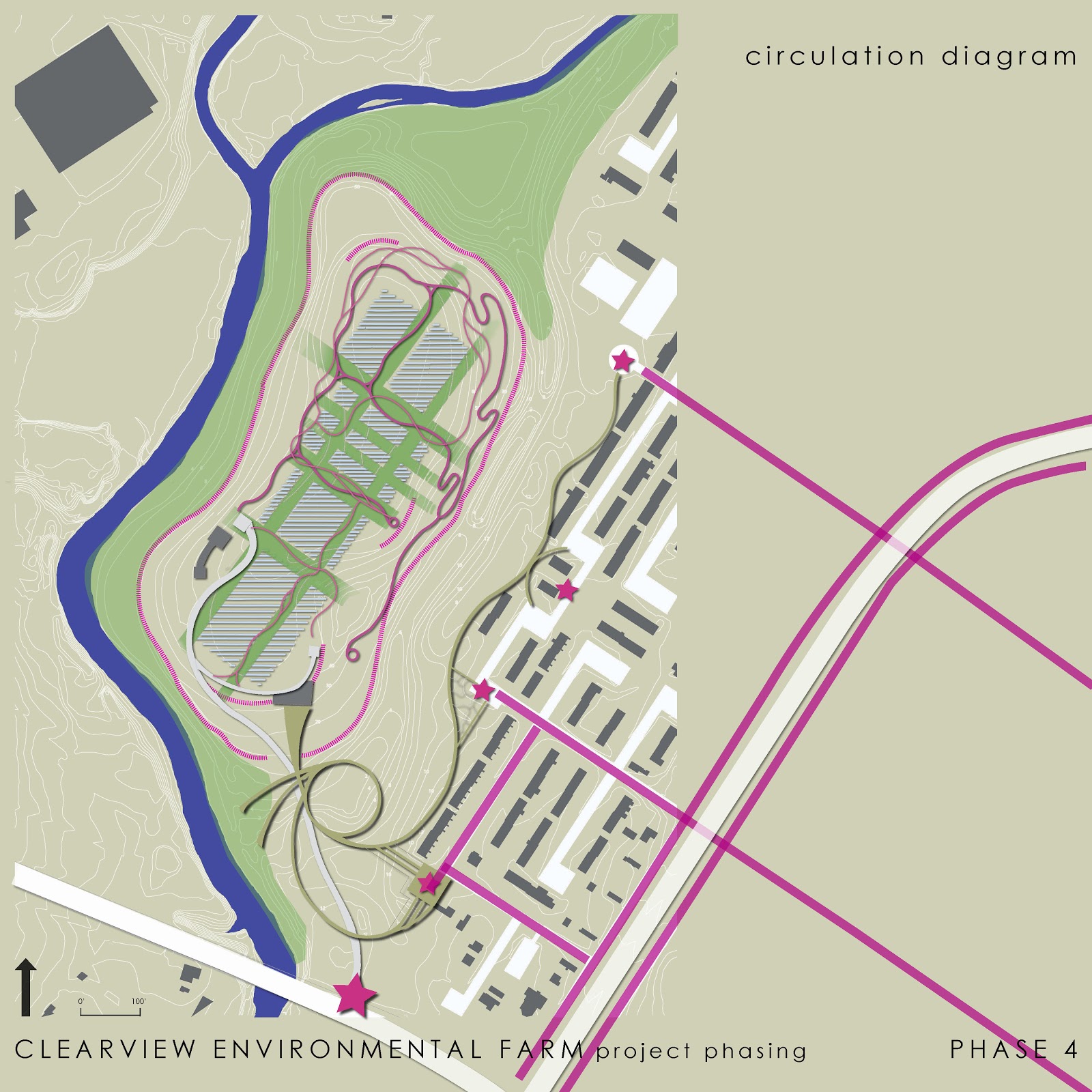
During the fall of 2011 Emily, along with colleague Dan Sharp, taught the "Public Lands" graduate-level studio in Temple University's Landscape Architecture ProgramThe purpose of the studio was to collectively  imagine possible design interventions that could enhance and improve the quality of the residents' lives for a community that is plagued by toxic pollutants and repeated flooding . The community lies within the Lower Darby Creek Area of Delaware and Philadelphia Counties in southeast Pennsylvania and includes 2 abandoned landfills (Clearview and Folcroft landfills), a community park, the Heinz wildlife refuge, and several neighborhoods and schools. In addition, the area has a rich and complicated history of being an important route along the underground railroad, and also being home to one of the largest urban renewal projects in the country. The academic exercise aimed at creating Sustainable Framework Plans at the community-scale and Landscape Designs at the site-scale for the community and represent the ideas of the students, molded by community input through a student-crafted survey. 

Two students from the studio, Anna Anisko and Donna Shumpert, won Honor Awards for their designs from the PA-DE ASLA Chapter. Anna won the honor award for general design for her project Clearview Environmental Farm and Donna won an honor award for analysis and planning for her project Energy Tanks. Both students, along with their classmates, devoted much time and resources to this project and the community. Congrats Donna, Anna and fellow students to a job well done!

For more information and images of the projects, please visit the class website here http://www.spandesigncan.org/eastwick---clearview-landfill.php


Image by Anna Anisko


Image by Anna Anisko


Image by Anna Anisko

Image by Anna Anisko


Image by Donna Deanne Shumpert

Image by Donna Deanne Shumpert

Image by Donna Deanne Shumpert