Showing posts with label community design. Show all posts

6.15.2012

Macro Intervention: A Play Street in Amsterdam

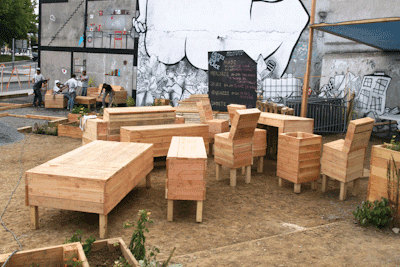
Photo courtesy of landezine.com

Potgieterstraat is situated in inner Amsterdam, in a context of 19th century buildings dating back to the first big enlargement of Amsterdam.  Amsterdam is world renowned for its walkability but this street in particular was heavily dominated with vehicle traffic.  In addition, new bike lanes had infortunately infringed upon the sidewalk rather than the vehicluar lanes.(1)

Carve Landscape Architects' response was to create a "Play Street" where the entire street was closed to all but bicycle and pedestrian traffic. 

Photo courtesy of landezine.com

(1) http://www.landezine.com/index.php/2012/06/potgieterstraat-by-carve-landscape-architecture/

12.31.2011

Micro Intervention: See Potential

Photo courtesy of Emily Schiffer


Similar to our last blog post on La Place du Geant  we would like to share this interesting spin on community based design visualization. Photographer Emily Schiffer has developed an idea that hopes to better serve communities suffering from poverty, blight, and underused infrastructure in the South Side of Chicago.  In partnership with Orrin Williams, the founder and director of the Center for Urban Transformation (CUT) [http://www.cutchicago.org/], she would like to engage the community with and public art with the goal of transforming urban blight into community potential.


With a focus on urban agriculture Schiffer would like to work with artists, photographers, and community leaders to use large-scale photographic installations and urban redevelopment as strategies for pre-visualizing a transformed landscape. Her hope is that this community cooperative approach will help to redirect attention towards solutions based in reality and "reframe individuals' relationships with food and foster new forms of healthy living."


The viability of urban agriculture in the United States is yet to be determined given the dominance of industrial farming operations. Family farms in rural areas all over the country are continuing to fail at an alarming rate.  If it can be accomplished in an manner that is economically and socially sustainable, perhaps part of the answer lies with urban agriculture.  The fact that it is unproven does not preclude attempts to create urban farms.  Organic farming at one time was considered a niche business, but it profitably continues now on a variety of scales.  Maybe the same can happen for urban agriculture.


We applaud Schiffer's project and value the creativity, courage, and vision it takes to make something like this happen.


To find out more about Schiffer's project, watch the video below or visit Kickstarter.


Photo and text courtesy of Kickstarter and Emily Schiffer.

12.30.2011

La Place du Geant


In July of 2011 Collectif Etc. brought to life their winning idea for a vacant urban property named by its neighborhood, La Place du Geant (officially named Place au Changement Public Plaza).  The project was selected in a competition sponsored by The Public Urban Planning Agency of (France) winning entry by the Collectif Etc.  

Developed as a temporary installation, its bold an unique strategy involved asking the community to imagine what the 7,000 sqft property might look like if it was filled with a building and then create structure that reflected that image. "The idea was to represent the plan of imaginary housings on the ground and their section on the wall."   People could then get a sense for what a future building might look like in that space.

Several workshops were offered that provided useful training in the form of carpentry, construction, graphic design, landscape design, and landscape maintenance. The construction was open to the public with Collectif Etc. acting as the oversight committee providing logistics, organization, and tools for the community.

Neighbors have given it the name, La Place du Geant  because of artists Ella&Pitr large painting.  Naming is an important part of place making; particularly a name given by its users.  Such an event connotes ownership and value.  And with an inclusive process to imagine the future, this neighborhood has created a space that has so far proved to be functional and social within its context.


All Photos Courtesy of Collectif Etc.

Jett , Megan . "Place au Changement Public Plaza / Collectif Etc" 31 Oct 2011. ArchDaily. Accessed 30 Dec 2011. <http://www.archdaily.com/179874> 

12.29.2011

A Citizen Architect and the Role of Design in a Land-Grant University

Photo Courtesy of The Rural Studio


 “That is the reason you go to college, not to make more money, but to gain the knowledge to make this a better world.”
– Sambo Mockbee


Citizen Architect is a well regarded film that highlights some of the best work done by the Rural Studio at Auburn.  It has been around a while, but its merits and the debate it inspires still hold true as it passionately lays out the role of Design in a land grant university.  It re-examines an age-old dispute carried forward from the inception of modernism and subsequently post-modernism, post-structuralism and deconstruction.  The movie does let Peter Eisenman eloquently express his point of view, however it clearly favors "architecture for the people" as opposed to "architecture as artistic expression".   The last part of that sentence wholly and unjustly oversimplifies both points of view because as with many theological debates, the more one tries to draw distinctions, the closer each becomes to the other.


Through this film one can see how the merits discussed during the now famous and expletive laced 1982 Harvard debate between Peter Eisenman and Christopher Alexander carries into the Land Grant vs. Ivy League discussion.   Again, that is a general statement that oversimplifies not only the role of each type of university but their position on the function of architecture in society.  But what is apparent, is that, in a manner similar to what is espoused by Alexander, Mockbee and the Rural Studio endeavor to build a reality of functional and esthetic architecture for undeserved communities.  Perhaps Mockbee's greatest contribution is the recognition that the idea of architecture as high art exists along a spectrum with socially conscious architecture.  That Design is not what one believes, it is what one makes.

Regardless of your worldview, or what university you attend, or attended, or teach at, Citizen Architect  should be required viewing for anyone in the architecture/landscape/planning/engineering fields, and especially those who are looking to enter those fields.


Photo Courtesy of samaulamockbee.net


7.11.2011

Micro Intervention: Farming at the Train Station

Photo Courtesy of the Mt. Airy Patch
An entire blog article can be written on the Point of Destination Cafe located in the Mt. Airy neighborhood in Philadelphia PA, and maybe later we will do that.  In short, they are a cafe located in the historic Upsal Train Station on the Chestnut Hill West line of the SEPTA train system and they brew a mean cup-a-Joe.  Its not their coffee we are interested in (for now) but their community outreach efforts.

When you enter, you will no doubt notice the corrugated cardboard chairs that were the result of a collaborative art and design project with the Charter High School for Architecture and Design. Again, this project alone warrants its own blog article, and maybe we will do that later as well.  However, we are interested on what you pass by before entering the building: the vegetable garden. 

The Cafe employees have teamed up with students from the Blair Christian Academy and are planting, weeding, and watering small garden plots.  The students have learned how to properly maintain the garden and have written narratives and/or haikus about their experiences.  Local artist and educator Troy Johnson lead an effort with the children to paint the outside of the garden boxes.

This is an inspiring effort, and serves as an important model for grassroots education.

Special thanks to Zach at the Mt. Airy Patch for his reporting!

4.03.2011

(a)bioitic Consults on New Allen Lane Station in Mt Airy

The Allen Lane station is located in the Mt. Airy neighbor hood of Philadelphia, PA.  It was constructed in 1880 and it's design is attributed to architect Frank Furness and now houses a well visited coffee shop.  In 1930 a wonderful pedestrian bridge spanned the tracks and blended smoothly with the station.  The building and bridge have stood as a stunning example of the Victorian style, and although they had fallen to disrepair, it was important to residents that their unique character be maintained. 

In August of 2009, reconstruction began with $6.9 million federal money. Construction can and often is difficult work and the Allen Lane project but was stalled by weather and other construction conflicts.  The renovations include adding ADA-accessible ramps (the platform itself was raised 4 feet) and outdoor shelters, as well as reconstructing the pedestrian bridge.  In addition, an ambitious planting plan should bring many beautiful and wildlife friendly native species.


Bidge and Platform Before construction.
In the summer of 2010 an initial and ultimately unsuccessful attempt at a landscape installation was made.  The soil was never properly stabilized and the proper planting soil was not used.  Many of the neighbors are anxious to see the project complete and since the initial landscape was a failure, are excited to see the landscape.

Because, of their experience with construction and planting Ben and Emily from (a)biotic design studio were asked to consult with SEPTA.   Along with a representative from the West Mount Airy Neighbor's Streetscape Committee as well as the leader of the local Town Watch, they were on a fact finding and networking mission to help the landscape reach its full potential. 


The landscape schedule is still undetermined and many of the ongoing maintenance conversations will not be able to take place until the plants are in the ground.  (a)biotic expressed their concerns regarding slope stabilization and tree protection but in general  communicated their satisfaction with the workmanship and quality of the bridge and hardscape construction.  SEPTA seemed to be as interested as the local residents to see the place succeed as a beautiful and functional social space that is enjoyed and cared for by the community.


Stay tuned for updates on construction and ribbon cutting dates!

2.11.2011

Micro Interventions: Neighborhood Bike Works

The Micro Intervention concept originates from an idea that small incremental change is a more effective and efficient use of resources for urban renewal than large scale planning and design efforts. Because these interventions are by virtue organic and community based, they are applicable, relevant and responsible within that community. Engineers, architects, planners, and landscape architects often fall prey to over-predation of urban design theory and forget that community design is more about designing with the community, rather than for the community. Micro Interventions move past theory and create a new reality of doing with rather than speaking to.

This concept will be explained more fully in future posts and will examine current practices in community design and provide what we think are outstanding examples of positive Micro Interventions.

The first in the series is the Neighborhood Bike Works. I had the opportunity last fall to sign up for a bike repair class offered at their home base in West Philly at 3916 Locust Walk. Neighborhood Bike Works are a nonprofit educational organization in Philadelphia that seeks to increase opportunities for urban youth through bicycling and to promote cycling as an environmentally friendly means of transportation.

There are a number of truly wonderful aspects about this nonprofit that take on the issue of "sustainability" from a grass routes level. They address issues of equity, education, and energy simultaneously.

Earn-A-Bike is their popular flagship program. Over the course of fourteen sessions, youth learn the basics of bike repair and maintenance, safe urban riding, and health and nutrition. Throughout the two month course, they also earn “hours”, which by the end of the course adds up to enough to take home their very own bike. These programs are free to the participants, as all costs are covered by Neighborhood Bike Works and partner organizations.


They have many bike repair classes for adults and children, a bike part art show, group rides and other community outreach efforts
. If you are interested, take a look at their website to see how you can participate.

http://neighborhoodbikeworks.org/