Showing posts with label micro intervention. Show all posts

12.02.2012

Micro Intervention: Urban Rainwater Harvesting

Photo courtesy of  aia.org
Australian inventor and architect Sally Dominguez's invention, the HOG system makes use of otherwise overlooked spaces for use as rainwater harvesting.  

The American Institute of Architects (AIA) reports that the inspiration for Dominguez’s rainwater harvesting system came to her while working on residential infill projects in inner-city Sydney. As a city on the edge of literally running out of water, it is no surprise that such innovations are spun from Australia.  Discouraged by the lack of small-scale solutions for stromwater storage, Dominguez  wanted to look beyond  the existing large-scale solutions the city has been exploring in recent years, (1)


Photo courtesy of aia.org
The HGO is a water storage system that makes use of spaces that are largely overlooked: underneath floors, inside walls, and along narrow alleys. She solved the problem of how to make flat-walled steel tanks fit in those spaces without bulging with the weight of their water by placing a hole in the middle of the container. In this way, the hole’s circular walls act as an inside-out brace (see below).It helped that Dominguez had some prior product development experience, and knew that the manufacturing method known as “rotomolding” (rotational molding) worked well for creating hollow plastics — and might apply equally as well to creating modules that could stand on any of their sides and join conveniently to the next one. Using this method, she created a highly scalable water storage system that can easily link one module to the next while allowing water to flow through them without impediment. (1)

The first Rainwater HOG tank debuted in Australia back in 2005, at a time when rainwater was still considered gray water (i.e., used household water). Thus the name: H2O Grey, or H2OG, or HOG. Now a version of the tank manufactured in the U.S. is available to the U.S. market, where the system has gained widespread popularity among green builders and architects in recent years.  (1)

We thought this was interesting in its potential application in places like Philadelphia and other large cites on the East Coast that are struggling to meet the EPA requirements for combined water/sewer outflows (CSO).  Obviously there would need to be a way to completely drain and bypass these during the winter months, but it is nothing that a little engineering can't handle.   Like many complicated urban problems, these tanks are far from a complete solution, but represent a step in the right direction.


Photo courtesy of aia.org
Works Cited
(1) earthtechling.com 
Thanks to JTLA for the heads-up on the story

9.09.2012

Solar Lounge Chair

Photo courtesy of inewidea.com
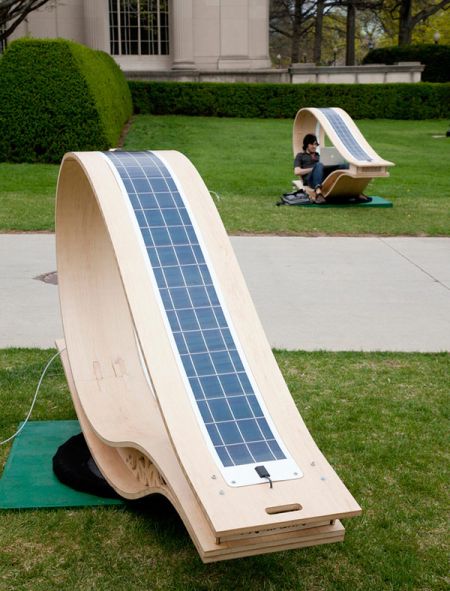
This tech-friendly solar powered sun lounger is designed by architecture students at MIT. You can recharge yourself and your electronics while relaxing with friends outdoors. The rocker uses the human power of balance to create an interactive 1.5 axis 35 watt solar tracking system. And it utilizes a 12 ampere hour battery storing the solar energy harvested during the day. For night time use, a strip of tape light will run along the interior of the lounger.


Photo courtesy of inewidea.com

Photo courtesy of inewidea.com

Photo courtesy of inewidea.com

Photo courtesy of inewidea.com

Photo courtesy of inewidea.com
WORKS CITED:  http://www.inewidea.com/2012/08/17/49977.html

8.13.2012

The Living Bridge


The narration is a bit over-the-top but it is still an amazing design and construction.

8.09.2012

RE-Cycle


Using nine dollars worth of materials, bicycle enthusiast Izhar Gafni has created a fully functioning, water-resistant bicycle, made, from seat to spokes, entirely of recycled cardboard. The technology makes the environmentalist's choice mode of transportation even a bit greener if not easier on the wallet.   (1)


“It's going to be a game-changer in the bike world,” says Giora Kariv, an Israeli artist and a longtime friend of Gafni's who made a documentary about the project. “Like Henry Ford who made the car available to anybody, this bike is going to be cheap and available to any child in the world, including children in Africa who walk dozens of miles to school everyday.” (1)

Check out the documentary below if you want to know more!


Izhar cardboard bike project from Giora Kariv on Vimeo.


CITATION: (1) http://www.good.is/post/cycle-on-the-recycled-a-9-cardboard-bike-set-to-enter-production-in-israel/

8.06.2012

Otro: A Glow-in-the-Dark Skate Park


In 2007, Korean-born (but Continental-living) Koo Jeong-a visited an island in the middle of France's Vassivière Lake for her exhibition, "Oussseux." Where a usual tourists might take a photo of the island's lighthouse and head back to land, the artist fell into a rapture over what she experienced as an "unreal, phantasmagoric and powerful dreamscape."

Don't listen to us, check out her artist statement:

"OTRO is an artwork made of bumps – the cradle – and hollows – bowls and tunnels. This work of Koo Jeong-A refers to both definitions of sculpture and representation: hollows and bumps, shadows and lights, soft or accentuated reliefs.

It is an art work to live, to experiment, not only from a sporting point of view but also from a sensorial, sensitive and artistic point of view. It establishes the link between the urban, practicable, sporting and playful aspect of the artwork as a skate park and the artwork from an artistic point of view as part of Koo Jeong-A’s world."


Koo Jeong-a worked with the Brussels-based L'Escaut Architectures and Belgium skate collectives Brusk and Barricade. It took about four years to complete, and has more than 2,000 square feet of surface area spread over several bowls and three tunnels.

If you are interested in glowing concrete, check out this article on Glowcrete and the product, Lumicrete.  Lumicrete claims to be environmentally friendly, but no such claim could be found on the Glowcrete product.


CITATION: 
(1) http://www.theatlanticcities.com/design/2012/08/glow-dark-skate-park-nocturnal-thrashing/2821/#.UBv8WNbZqDo.facebook

(2) All photos courtesy of L'Escaut Architectures.


8.02.2012

Micro Intervention From The Past: Outdoor Baby Cage

  Photo courtesy of Getty Images.


We are not sure that these images and this very old practice of caging your baby outside a window sometimes several stories above terra firma necessarily fits in with the general ziteguiste of our blog, but it was so amazing we had to share.  The images themselves border on art by simply reflecting an extremely bad idea from the 1930s.


The photo above was taken in 1934 shows a wire cage which East Poplar borough council in London proposed to fix to the outside of their buildings. (1)

The patent was filed in 1922 by Emma Read, from Washington, and was granted the following year. According to The Northern Star, the description of the patent, said: 'It is well known that a great many difficulties rise in raising, and properly housing babies and small children in crowded cities, that is to say from the health viewpoint.(1)  So apparently the benefits would be fresh air for the child, room to play with toys and another place for children to sleep...sure that makes sense.

The patent went on:  'With these facts in view, it is the purpose of this invention to provide an article of manufacture for babies and young children, to be suspended upon the exterior of a building adjacent an open window, wherein the baby or young child may be placed.' (1)

The cages in the patent were also designed with a slanted, overlapping roof which was said to protect babies from snow or rain.(1)

  Photo courtesy of Getty Images.
  Photo courtesy of Getty Images.


7.27.2012

Micro Intervention: The Boneyard Project


'The Boneyard Project' is an effort initiated by art patron Eric Firestone at the the cemetery of disused war planes in Arizona  to resurrect disused planes from throughout America’s military history.  It has attracted more than 30 of the world’s best urban artists worked on five ruined US Air Force jets, vividly bringing them back to life with paint and color. (1)


The first part of the Boneyard Project, 'Nose Job', made its debut in the summer of 2011 with an exhibition of nose cones taken from military airplanes and given to artists to use as eccentric- shaped "canvases". The second installment in this series: Round Trip: Selections from The Boneyard Project, features five monumental works created on military planes by a dynamic selection of popular graffiti and street artists from around the world.  (1) 

The show is on display at the Pima Air and Space Museum in Tucson until mid-May.  (1)


NOTE:  All photos courtesy of designyearbook.com


7.23.2012

Aluminum Boys

Photo Courtesy of thisiscolossal.com
Artist Gregor Gaida lives and works in Bremen, Germany. His figurative and downright trippy sculptures often depict aggressive, even violent people engaging with each other under unknown circumstances, as with this pair of mischievous aluminum boys titled Attaboys. Gaida says that he often bases his figures off of images found in magazines and books. (1)


The found footage is often no more than an impulse that is no longer discernible in the further development of the shape. Analogous to photography, my objects are three-dimensional snapshots. The characters are frozen in movement and often cropped along imaginary image borders. I transport the fragmented character of photos into the third dimension. Simultaneously, when dealing with color and options of shaping, painterly characteristics appear. Thus, the life-sized special interventions are formally attributed to sculpture but are equally part of painterly and photographic categories. (1)
Photo Courtesy of thisiscolossal.com
Attaboys appears to be a reinterpretation of another set of sculptures from 2008, Kind und Kreide II, where two similar boys are seen drawing a line with chalk. It's unclear if the artist intends to draw a parallel between the two works, but I’m going to go with it. It leaves one hoping to see what they’ll be up to in four years from now. If you happen to be in Germany you can see Gaida’s work at PARROTTA Contemporary Art in Stuttgart through August 4th. All imagery courtesy the artist and PARROTTA Gallery. (via Anita Leocadia) (1)
Photo Courtesy of thisiscolossal.com


Photo Courtesy of thisiscolossal.com

Photo Courtesy of thisiscolossal.com

Photo Courtesy of thisiscolossal.com

Photo Courtesy of thisiscolossal.com

7.13.2012

Micro Intervention: "Parc du Chateau”

Photo courtesy of Francois Mechain
Self proclaimed photographer and moving sculptor, François Mechain creates playful and ephemeral works where items of our modern everyday work or home are juxtaposed in against a natural setting.  This is a good example of his Inspiring and sometimes haunting these well photographed pieces.


6.28.2012

Micro Intervention: Grass-Jubilee?

Photo courtesy of gardendesign.com
Always interested in the obsession with turf, we stumbled across this odd micro intervention when, on June 8, 2012, the York Minister Cathedral held a dinner inside the cathedral.as part of the celebrations for Queen Elizabeth II's Diamond Jubilee. (1)   16,145 square feet of the 14th-century gothic cathedral's nave—the largest one in Northern Europe—was covered in filter fabric and then a specialized turf called WowGrass. (1)  Sorry sod-loving Yanks, looks like they are based out of England.

Photo courtesy of gardendesign.com

Photo courtesy of gardendesign.com

Photo courtesy of gardendesign.com

Photo courtesy of gardendesign.com
(1) http://www.gardendesign.com/lawn-care/crazy-plant-trend-of-the-day-grass-covered-cathedral-nave?cmpid=enews062612&spPodID=020&spMailingID=4616195&spUserID=MTMzNzcwODIxOTIS1&spJobID=276559533&spReportId=Mjc2NTU5NTMzS0

6.18.2012

Cloud Terrace


Photo courtesy of caoperrotstudio.com
"Cloud Terrace takes the form of a hand‐sculpted wire mesh cloud suspended over the terrace and embellished with 10,000 genuine SWAROVSKI ELEMENTS water‐drop crystals mirrored in a reflecting pool. The Arbor Terrace is one of the most modified spaces in the Dumbarton Oaks Gardens. Originally designed by Beatrix Farrand in the early 1930s as a simple rectangular herb garden bordered on the west by a wisteria‐covered arbor and on the east and north by a hedge of Kieffer pears, it was refashioned by Farrand’s former associate Ruth Havey in the 1950s as a pot garden centered on a Rococo‐style parterre with low, Doria stone parapet walls. The space can be hot and bright; cao | perrot’s installation is a response to these conditions, extending the shade of the arbor across the terrace and animating the space inside the parterre with an oval pool surrounded by pebbles. (1)

The project was supported by SWAROVSKI ELEMENTS, who provided the crystals used for the installation. It was organized by John Beardsley, Director of Garden and Landscape Studies at Dumbarton Oaks, and Gail Griffin, Director of Gardens."
Dumbarton Oaks Press Release (March 28, 2012)(1)


Dumbarton Oaks, Washington DC
cao | perrot studio with J.P. Paull (Bodega Architecture)
Wire mesh, steel posts, cut crystals SWAROVSKI ELEMENTS, reflecting pond, plants(1)


(1)caoperrotstudio.com