9.09.2012

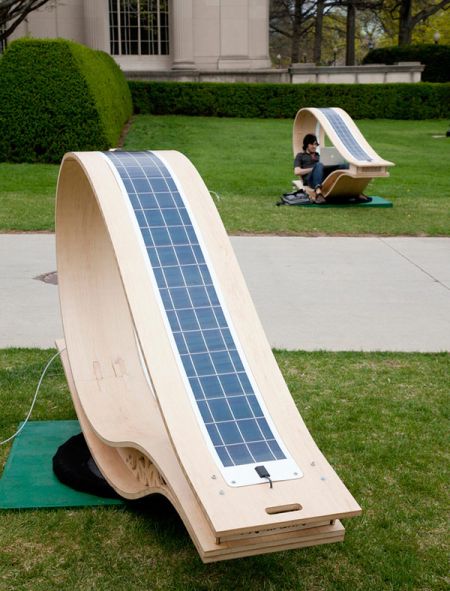
Solar Lounge Chair

Photo courtesy of inewidea.com
This tech-friendly solar powered sun lounger is designed by architecture students at MIT. You can recharge yourself and your electronics while relaxing with friends outdoors. The rocker uses the human power of balance to create an interactive 1.5 axis 35 watt solar tracking system. And it utilizes a 12 ampere hour battery storing the solar energy harvested during the day. For night time use, a strip of tape light will run along the interior of the lounger.


Photo courtesy of inewidea.com

Photo courtesy of inewidea.com

Photo courtesy of inewidea.com

Photo courtesy of inewidea.com

Photo courtesy of inewidea.com
WORKS CITED:  http://www.inewidea.com/2012/08/17/49977.html

9.05.2012

Quebec’s International Garden Festival

Fractal Garden by leggelewislegge

This year marks the 13th edition of  Quebec’s quirky International Garden Festival. It is held through Sept. 30 on the grounds of Jardins de Metis (aka Reford Gardens). This year’s 26 featured gardens (chosen from some 158 projects submitted) are intentionally interactive. Visitors can climb rope ladders; walk through a field of wind-whipped grasses (blown by high-powered fans); explore a sky-reaching, tubular fortress; or sit on a twisting wall of moss-filled honeycomb panels (pictured above). A few gardens will also return from last year. “The combination of new and old offers a dialogue between maturity and temporality,” explains director Alex Reford. “With the returning gardens of Ken Smith, Diana Balmori, and Michael Van Valkenburgh and those by designers from other parts of the world, the festival offers an extraordinary range of installations that illustrate the many approaches to landscape and garden design.”
Leire Asensio-Villoria and David Syn Chee Mah worked with students at Harvard University’s Graduate School of Design
Though the organizers regularly curate extra-mural exhibits throughout Canada, this year they also presented an installation in London at the new Chelsea Fringe festival. Floating Forest, created by Montreal designers NIPpaysage, featured a grid of 1,000 floating tree trunk slices in the Grand Union Canal. “The effect,” says Reford, “is one that illustrates the unique ability of landscape architects to reimagine public spaces and to make them come to life.”

8.16.2012

The Dutch Know Bikes


The Dutch build bicycle lanes into the intersections to remove the need for the driver of a vehicle who wants to turn right from having to look over their shoulder.  A tricky maneuver for anyone driving, healthy neck or not. It is my take that the bike wanting to go "straight" maintains the right of way.   Its a really interesting concept and removes the need to widen the corner.  Check it out:


8.13.2012

The Living Bridge


The narration is a bit over-the-top but it is still an amazing design and construction.

8.09.2012

RE-Cycle


Using nine dollars worth of materials, bicycle enthusiast Izhar Gafni has created a fully functioning, water-resistant bicycle, made, from seat to spokes, entirely of recycled cardboard. The technology makes the environmentalist's choice mode of transportation even a bit greener if not easier on the wallet.   (1)


“It's going to be a game-changer in the bike world,” says Giora Kariv, an Israeli artist and a longtime friend of Gafni's who made a documentary about the project. “Like Henry Ford who made the car available to anybody, this bike is going to be cheap and available to any child in the world, including children in Africa who walk dozens of miles to school everyday.” (1)

Check out the documentary below if you want to know more!


Izhar cardboard bike project from Giora Kariv on Vimeo.


CITATION: (1) http://www.good.is/post/cycle-on-the-recycled-a-9-cardboard-bike-set-to-enter-production-in-israel/

8.06.2012

Otro: A Glow-in-the-Dark Skate Park


In 2007, Korean-born (but Continental-living) Koo Jeong-a visited an island in the middle of France's Vassivière Lake for her exhibition, "Oussseux." Where a usual tourists might take a photo of the island's lighthouse and head back to land, the artist fell into a rapture over what she experienced as an "unreal, phantasmagoric and powerful dreamscape."

Don't listen to us, check out her artist statement:

"OTRO is an artwork made of bumps – the cradle – and hollows – bowls and tunnels. This work of Koo Jeong-A refers to both definitions of sculpture and representation: hollows and bumps, shadows and lights, soft or accentuated reliefs.

It is an art work to live, to experiment, not only from a sporting point of view but also from a sensorial, sensitive and artistic point of view. It establishes the link between the urban, practicable, sporting and playful aspect of the artwork as a skate park and the artwork from an artistic point of view as part of Koo Jeong-A’s world."


Koo Jeong-a worked with the Brussels-based L'Escaut Architectures and Belgium skate collectives Brusk and Barricade. It took about four years to complete, and has more than 2,000 square feet of surface area spread over several bowls and three tunnels.

If you are interested in glowing concrete, check out this article on Glowcrete and the product, Lumicrete.  Lumicrete claims to be environmentally friendly, but no such claim could be found on the Glowcrete product.


CITATION: 
(1) http://www.theatlanticcities.com/design/2012/08/glow-dark-skate-park-nocturnal-thrashing/2821/#.UBv8WNbZqDo.facebook

(2) All photos courtesy of L'Escaut Architectures.


8.02.2012

Micro Intervention From The Past: Outdoor Baby Cage

  Photo courtesy of Getty Images.


We are not sure that these images and this very old practice of caging your baby outside a window sometimes several stories above terra firma necessarily fits in with the general ziteguiste of our blog, but it was so amazing we had to share.  The images themselves border on art by simply reflecting an extremely bad idea from the 1930s.


The photo above was taken in 1934 shows a wire cage which East Poplar borough council in London proposed to fix to the outside of their buildings. (1)

The patent was filed in 1922 by Emma Read, from Washington, and was granted the following year. According to The Northern Star, the description of the patent, said: 'It is well known that a great many difficulties rise in raising, and properly housing babies and small children in crowded cities, that is to say from the health viewpoint.(1)  So apparently the benefits would be fresh air for the child, room to play with toys and another place for children to sleep...sure that makes sense.

The patent went on:  'With these facts in view, it is the purpose of this invention to provide an article of manufacture for babies and young children, to be suspended upon the exterior of a building adjacent an open window, wherein the baby or young child may be placed.' (1)

The cages in the patent were also designed with a slanted, overlapping roof which was said to protect babies from snow or rain.(1)

  Photo courtesy of Getty Images.
  Photo courtesy of Getty Images.


7.30.2012

Macro Intervention: Glass Beach


Quite possibly the most beautiful dump in the world, no amount of  intellectual design effort that is now currently applied to projects such as Fresh Kills in NYC could possibly hope to create the tumbled glass splendor at Glass Beach.  Only decades of waste disposal hurled off of the cliffs at Fort Bragg, California  by its residents could make something that amazes in its dichotomous splendor. They discarded glass, appliances, and even cars. The land was owned at that time by the Union Lumber Company, and locals referred to it as "The Dumps." Sometimes fires were lit to reduce the size of the trash pile.


In 1967, the North Coast Water Quality Board and city leaders closed the area. Various cleanup programs were undertaken through the years to correct the damage.


Over the next several decades the pounding waves cleansed the beach, wearing down the discarded glass into the small, smooth, colored trinkets that cover the beach today.  In 2002, the California State Park system purchased the 38-acre (150,000 m2) Glass Beach property, and after cleanup it was incorporated into MacKerricher State Park.


NOTE:  Photos courtesy of ++ Colossal


http://www.thisiscolossal.com/2011/08/glass-beach/
http://en.wikipedia.org/wiki/Glass_Beach_(Fort_Bragg,_California)


7.27.2012

Micro Intervention: The Boneyard Project


'The Boneyard Project' is an effort initiated by art patron Eric Firestone at the the cemetery of disused war planes in Arizona  to resurrect disused planes from throughout America’s military history.  It has attracted more than 30 of the world’s best urban artists worked on five ruined US Air Force jets, vividly bringing them back to life with paint and color. (1)


The first part of the Boneyard Project, 'Nose Job', made its debut in the summer of 2011 with an exhibition of nose cones taken from military airplanes and given to artists to use as eccentric- shaped "canvases". The second installment in this series: Round Trip: Selections from The Boneyard Project, features five monumental works created on military planes by a dynamic selection of popular graffiti and street artists from around the world.  (1) 

The show is on display at the Pima Air and Space Museum in Tucson until mid-May.  (1)


NOTE:  All photos courtesy of designyearbook.com


7.23.2012

Aluminum Boys

Photo Courtesy of thisiscolossal.com
Artist Gregor Gaida lives and works in Bremen, Germany. His figurative and downright trippy sculptures often depict aggressive, even violent people engaging with each other under unknown circumstances, as with this pair of mischievous aluminum boys titled Attaboys. Gaida says that he often bases his figures off of images found in magazines and books. (1)


The found footage is often no more than an impulse that is no longer discernible in the further development of the shape. Analogous to photography, my objects are three-dimensional snapshots. The characters are frozen in movement and often cropped along imaginary image borders. I transport the fragmented character of photos into the third dimension. Simultaneously, when dealing with color and options of shaping, painterly characteristics appear. Thus, the life-sized special interventions are formally attributed to sculpture but are equally part of painterly and photographic categories. (1)
Photo Courtesy of thisiscolossal.com
Attaboys appears to be a reinterpretation of another set of sculptures from 2008, Kind und Kreide II, where two similar boys are seen drawing a line with chalk. It's unclear if the artist intends to draw a parallel between the two works, but I’m going to go with it. It leaves one hoping to see what they’ll be up to in four years from now. If you happen to be in Germany you can see Gaida’s work at PARROTTA Contemporary Art in Stuttgart through August 4th. All imagery courtesy the artist and PARROTTA Gallery. (via Anita Leocadia) (1)
Photo Courtesy of thisiscolossal.com


Photo Courtesy of thisiscolossal.com

Photo Courtesy of thisiscolossal.com

Photo Courtesy of thisiscolossal.com

Photo Courtesy of thisiscolossal.com