12.02.2013

Radical Cartography


Photo courtesy of architizer.com/blog/radical-cartography
With Design with Nature, Ian McHarg pioneered the concept of ecological planning. Mcharg did not invent cartography, a practice that can be traced back to the ancient Greeks (what can't?), nor did he necessarily invent applied cartography: that is often attributed to fellow Scotsman, Patrick Geddes. In 1915, his suggestion that plans be made for Place, Work, Folk spawned the method of planning-by-layers (Meller 1990, 46). 1

 
Getty's Place / Work / Folk:.  Photo courtesy of ds.cc.yamaguchi-u.ac.jp
Suitability Analysis from Design With Nature
McHarg was successful in clearly documenting and describing the layered analysis process, and  has been considered one of the premiere minds in landscape ecology, planning, and architecture. Perhaps a less well known, but no less inspiring counterpart can be found in William Bunge, Jr. who looked at and mapped cultural behavior in and around Detroit. Bunge's work was similar to that of William “Holly” White, a master urbanist, organizational analyst, journalist and people-watcher in his own right, but at the same time, much, much different.


Bungle, scaring the government.  Photo courtesy of architizer.com/blog/radical-cartography
Photo courtesy of architizer.com/blog/radical-cartography

The distinction lies in the fact Bunge’s maps are as argumentative as he is.  They demand social equality for a community that was ignored and abandoned and record it as a snapshot of truth in time. He mapped unconventional measurements:  quantities of store bought toys and rat bites, to mark the disturbing inequity he saw before his eyes. In one map, he compares the number of bars to the number of playfields in each Detroit neighborhood. Another, titled "Where Commuters Run Over Black Children," is an indictment of poverty, white flight, and President Gerald Ford himself. Below are excepts from Fitzgerald and An Atlas of Love and Hate; these maps portray Bunge's time in Detroit, and his ability (and sometimes inability) to organize the landscapes around him. 2

He shown a light on the way things were in a way that the powers that be at the time were not comfortable with. He wasn’t talking about how to better gentrify a park in NYC or how to build out the Jersey Shore. He was dangerous because he focused on the minute patterns of human movement and behavior, revealing the machinery that orchestrates our activities. His maps are based on statistics, truth, and "damn good graphic design." 2

For his efforts, again and again he lost tenure and was briefly blacklisted by the United States government as a communist sympathizer. Bunge published An Atlas of Love and Hate: Detroit Geographies in 1969, then followed it in 1971 with Fitzgerald: Geography of a Revolution (Geographies of Justice and Social Transformation). Due to his combination cartographer/community activist role, his maps are both a romantic time capsule and an invaluable source of access to a period of fundamental change in the "Great American City." Mathematically exact yet gentle, Bunge lived in the communities he mapped, and his maps remain haunting and inspirational artifacts through which we can watch the Detroit of our grandparents become the Detroit of our parents.2


Photo courtesy of architizer.com/blog/radical-cartography


1 http://jedroberts.com/documents/jed_roberts_geo515.pdf

2  http://architizer.com/blog/radical-cartography/

11.24.2013

Terrasuisse


Natural Habitat - Mladen Penev - Staudinger + Franke
Terrasuisse stands for products of sustainable swiss agriculture which garantees natural habitat for endangered animals.

11.21.2013

Yes, Handbags, But What Else?

Photo courtesy of Tesler Mendelovitch
Recently we discovered this post on one of our favorite sites, Materia. Innovation for Design at different scales comes from inspiration at multiple scales. The handbags from Tesler Mendelovitch got the gears turning in our heads...how can this be used in architecture? in the landscape?

The principle for the Tesler Mendelvotich work is visible in a range of work based on what the designers call ‘diamond wood’ geometric surface finishing. The wood-textile fusion, similar to materials such as Foldtex, has led to plinths, pedestals and small tables. Recently, this work branched out into wearable pieces. The advantage of the wood-textile combination here is that it answers to users’ requirements. As an example, clutch purses made from the material provide the necessary resilience and hear-wearing attributes, while also being flexible and soft to the touch.1


Photo courtesy of Tesler Mendelovitch

Photo courtesy of Tesler Mendelovitch

The studio has settled on a few designs, incorporation various types of wood that suit the design type well. Although the process is not visible, the resulting forms are the result of many generations of design refinement and testing. Tesler Mendelovitch experiments with wood, cutting, folding and bending.1

With any material, but especially with wood, it takes time to understand the material. The particular lesson here is that working on the scale of the material itself – small panels of lightweight wood – allows the designer to learn from the wood.1  The applications of lessons learned from these microscale creations have yet to be discovered...maybe you can send us your ideas!

5.20.2013

The Hypnosis and Inspiration of the Curvilinear


Hypnotic and Inspirational:  what a truly amazing form
We saw this in the New York Times and just had to share.  In his new book “Serpentine,” Mark Laita (Abrams, $50), presents us images of snakes photographed against a dark background that represent a shocking depiction of beauty in Nature. In his prologue Mr. Laita,,” tries to articulate what it is about snakes that spurred him to take on this project: “Attraction and repulsion. Passivity and aggression. Allure and danger. These extreme dichotomies, along with the age-old symbolism connected with snakes, are what first inspired me to produce this series.”


Works Cited:
1 http://nyti.ms/15Hkgw4
2 All images courtesy of the NY Times 

5.06.2013

When Humor and Creativity Collide


I know this entry is stretching it for this blog but from time to time we like to indulge our love of animation.  We also have, shall we say, a healthy sense of humor.  Case in point, this guy, Adam Patch, animated a joke told by his drunk wife and it is hilarious, in a good clean way...unless of course you are, on face value, horribly offended by corn chips. But really how awesome and creative and did I say awesome is it to actually take the time to animate something like that?  Let's hope it's true...but it would be really funny sans the intoxication angle as well.

Adam, my man, you are our newest hero!


"Two Chips" / An Animated Short from Adam Patch on Vimeo.

5.03.2013

Chicago To America: "We Have The Greenest Streets!"

1. Bike lanes adjacent to parking lane; 2. Bike rack; 3. Bioswale planter (removes silt and pollution from surface runoff; 4. Solar bus shelter; 5. White light lamp (40% more energy efficient); 6. 100% post-consumer recycled content used for sub-pavement levels; 7. Light-colored pavement (39% of hardscape is reflective pavement); 8. Reflective pavement to mitigate urban heat island effect; 9. Pervious parking and bike lanes with detention area made from recycled materials.
Chicago may be known as a gritty, rust belt city, but lately they are looking more and more like a city that is trying to innovate its way out of a downward spiral that unfortunately affects many of the aging cities in that region (see also Detroit, Cleveland, etc). Case in point: the Chicago Department of Transportation (CDOT) late last year "unveiled the first phase of their “greenest street in America” project. Located on a 1.5-mile stretch of Cermak Road in Chicago’s Pilsen neighborhood, the street is made with air pollution-eating materials and features solar panels, native plants and stormwater-sucking pavement, among other impressive technology. The street’s success has since launched the city into the national limelight for innovative planning and design."1


Photo courtesy of inhabitat.com
This is an interesting claim, but lets unpack this claim a little and dive in to as many of the details as we can.

According to CDOT, this is the first commercial roadway application of photocatalytic concrete. We currently drafting a reasearch article on photocatalytic concrete but right now it looks like pretty amazing stuff. Imagine if you will, an abiotic material that not only cleans itself but also pulls carbon out of the air. The concrete’s "nanotechnology absorbs nitrogen oxide (i.e. car exhaust) from the air and cleans the road’s surface through a sunlight-powered reaction. The process uses titanium dioxide, so it’s not all roses — mining and chemical processing are needed to get titanium dioxide — but it’s a great application of the pigment. The sidewalk concrete uses more than 30 percent recycled content, and the cement’s reflectivity reduces the urban heat island effect."1 In this case it is worked into a road surface, but there are other possibilities, and something that looks to good to be true should be investigated further before we all start trumpeting it as the end-all be-all to global warming. Please stay tuned for our more extensive research!

On a more well known and tested note, they have incorporated stormwater capture where the "street diverts close to 80 percent of rainfall from the sewer system through permeable surfaces, rain gardens and street trees." The State of Illinois agreed to an Clean Water Act settlement consent decree with the EPA, the Department of Justice (DOJ), and with "the Metropolitan Water Reclamation District of Greater Chicago (MWRD) to setlle a court case under the Clean water Act relating to Chicago's combined sewer system which during times of heavy rainfall results in combined sewer overflows (CSOs) into Lake Michigan and other water bodies. The settlement requires upgrading Chicago’s sewer infrastructure to reduce combined sewage overflows. The legally binding settlement mandates that MWRD make critical structural changes to improve the quality of Chicago’s waterways and includes green infrastructure projects to reduce runoff."2

The re-use of this runoff and plant selection in the CDOT solution eliminates the need for potable irrigation water. A wind and solar-powers the lighting system with LEDs. To complete their Green Infrastructure intervention, a half-mile of bike lanes. Sidewalks are made more walkable with a pedestrian refuge island — "which separates crossing pedestrians from motor vehicles — and curb-corner extensions that allocates more street space to pedestrians. CDOT also created educational signage and a walking tour brochure." 1

So the big question is, how much does this intervention cost? The near $14 million for the mile-and-a-half-project comes out to around $88 per square foot if you assume a 60' Right Of Way. "Funding came from Tax Increment Financing and assorted grants from the Federal Highway Administration, Illinois Environmental Protection Agency, and Midwest Generation. "1


Photo courtesy of inhabitat.com


WORKS CITED
www.gridphilly.com/grid-magazine/2013/3/11/steal-this-idea-chicago-street-cleans-the-air.html
geospatial.blogs.com/geospatial/2011/12/chicago-agrees-to-combined-sewer-overflows-consent-decree.html

5.02.2013

Bike Share

Photo from bike-sharing.blogspot.com
The official start of The National Bike Challenge, a nationwide effort to increase bicycle ridership through camaraderie and friendly competition was yesterday.  To commemorate the kick-off, Alta Planning and Design was in Philadelphia displaying the wares of their successful Bike Share program.


I met with Fionnuala Quinn and Charlie Denney who were excited to tell me about their bikes and their expanding Bike Share program. Alta Bicycle Share designs, deploys, and manages bicycle share programs and systems worldwide. They launched and manage Melbourne Bike Share in Melbourne, Australia, Capital Bikeshare in Washington, DC, Hubway in Boston, MA, and Chattanooga Bicycle Transit System in Chatanooga, TN.

Alta is an exciting company who in addition to there planning and design efforts are, at any given time, actively working on several bike-share projects and studies for jurisdictions and companies interested in bringing bike share to their communities. Alta has locations all over the country - Pacific Northwest, California, the mountains and the desert, Midwest, and up and down the east coast and are considered experts in pedestrian and bicycle planning, green space design, and research and innovation in planning and design.

I had the opportunity to intern for Chuck Flink at Greenways Inc., which is now Greenways/Alta, in Durham NC. It was a terrific experience and highly recommend it to any aspiring planners or landscape architects out there. 

As Emily and I have continued our discussions on the definitions of "Green Infrastructure" we definitely consider the impact and importance of bicycles on urban design. Alta is conducting research on how a seemingly nano-intervention of a bike share can help transform the way people experience the city but perhaps more importantly how a city infrastructure's will morph in response to that use. Stay tuned!

5.01.2013

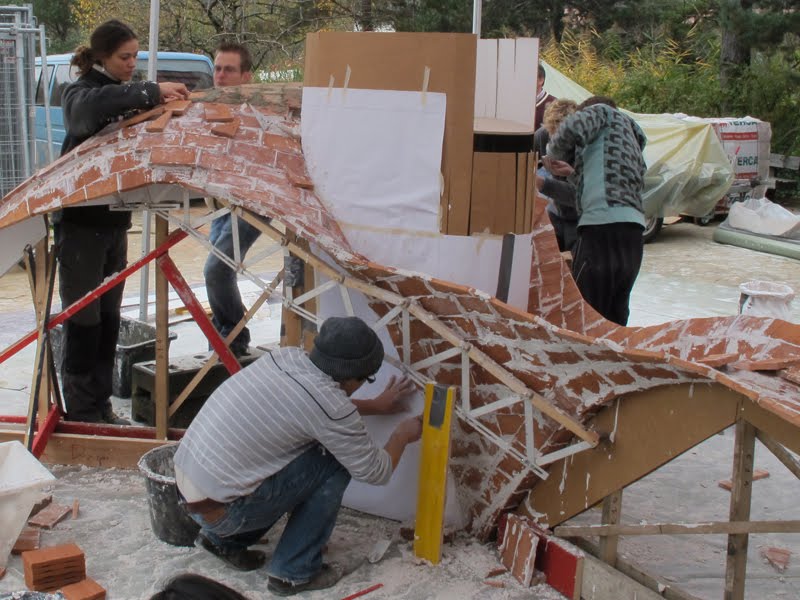
Bending Masonry

Photo Courtesy of eat-a-bug.blogspot.com
 Check out this "Catalan free-form vault has been designed and build by students during a one week workshop organised by Prof. Deplazes and Prof. Block from ETH Zurich. RhinoVAULT has been used for the design of the complex compression-only shape. For details, visit the homepage of the BLOCK Research Group."1


WORKS CITED
1 http://eat-a-bug.blogspot.com/2012/11/masonry-workshop-at-eth-zurich.html 

4.30.2013

A New Building that Uses Algae for Energy


"A grounbreaking new building in  Hamburg, Germany, "intends to generate heat, as well as revenue, from growing the micro-organism. The five-story Bio Intelligent Quotient (B.I.Q.) building, which was expected to become fully operational on Wednesday, has a high-tech facade that looks like a cross between a Mondrian painting and a terrarium but is actually a vertical algae farm."1

"Lukas Verlage, managing director of the Colt Group, part of the high-powered consortium that constructed the energy system, said in an e-mail that the building was “an outstanding and important development in the use of renewable resources in building technology,” comparable to advances in the space program."1


"And Rainer Müller, press officer of the International Building Exhibition, which introduced a competition in 2009 that led to the creation of the B.I.Q. house, said, “Using algae as an in-house energy source might sound futuristic now, but probably will be established in 10 years.”
The competition, won by a consortium including the Colt Group, asked entrants to use smart materials, defined as “systems and products that behave dynamically, unlike conventional building materials, which are static.”1


Read the complete New York Times article here:
When Algae on the Exterior Is a Good Thing


WORKS CITED:
1  http://www.nytimes.com/2013/04/25/business/energy-environment/german-building-uses-algae-for-heating-and-cooling.html?pagewanted=1&_r=0
2  All images courtesy of the NY Times

4.25.2013

Photography of the (a)biotic


"Two Kyrgyzstan-based photographers, Andrew and Luda, run a joint Live Journal account where they post amazing photos of outdoor scenery, wildlife, and recently: active volcanoes." We love the image above in particular for its metaphorical and literal translation of the biotic and abiotic elements that define our vision as designers.


"Earlier this year the duo trekked to the Kamchatka Peninsula in Russia where the volcano complex known as Tolbachik was in active eruption. Among the numerous hellish vistas photographed by the team was this deep volcanic cave that offered a glimpse of what it might look like below the Earth’s crust. You can see dozens of shots from their trip organized into several sets here, not to mention the video below. (via ian brooks, my modern met)"


WORKS CITED
1  http://www.thisiscolossal.com/2013/04/journey-to-the-center-of-the-earth-an-incredible-glimpse-inside-an-active-volcano/. 
2 All images courtesy of thisiscollassal or Tolbachik unless otherwise noted.